Concise answer
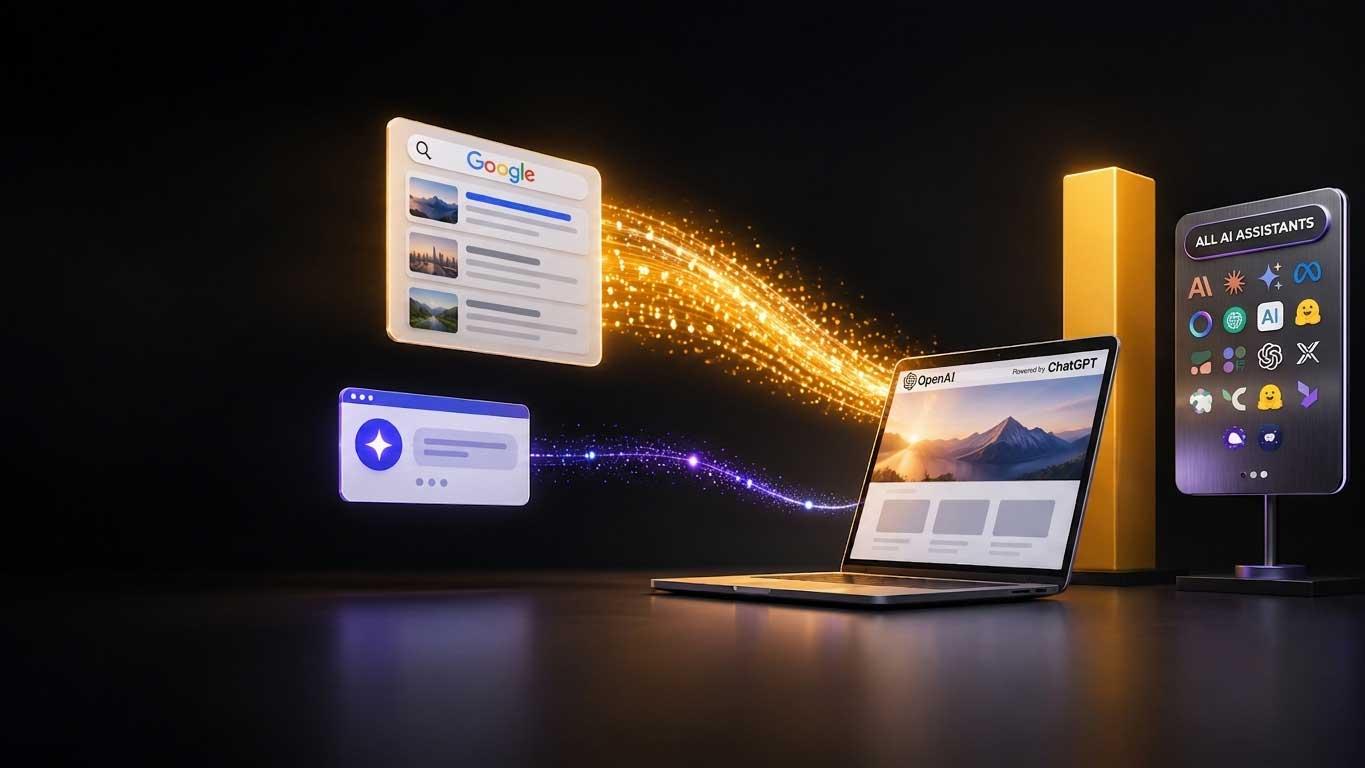
For most businesses, AI search optimisation is worth a small, measured test, not a large separate budget. Studies published in October 2026 found AI assistants sent between roughly 0.6% and 2.6% of the traffic Google organic search sent, though some AI visitors converted at higher rates. None of the studies focused on Indian websites, so check your own analytics first. Strong content, technical SEO, and site speed help in both Google and AI answers, so they remain the best place to spend.
Marketing teams are being pitched a new service almost every week: generative engine optimisation, answer engine optimisation, AI visibility tracking. The promise is that customers now ask ChatGPT, Gemini or Perplexity instead of Google, and brands that are not cited in AI answers will be left behind.
In October 2026, three separate analyses of real website analytics put that promise to the test. Their findings were consistent: AI assistants do send visitors, but far fewer than Google, and the visitors they send do not always convert better. For marketing heads at D2C brands, B2B firms and logistics companies, that changes where the next rupee of search budget should go.
What GEO and AI Overviews mean
A few terms come up in almost every AI search pitch. Here is what each one means in plain language.
| Term | What it means |
|---|---|
| GEO (generative engine optimisation) | Work aimed at getting a brand mentioned or cited in answers from AI tools such as ChatGPT, Gemini, Perplexity and Copilot |
| AEO (answer engine optimisation) | A similar idea, focused on being the source behind direct answers |
| AI search optimisation | A general term covering GEO, AEO and visibility in Google's own AI features |
| AI Overviews | AI-generated summaries that appear at the top of many Google search results, with links to the sources used |
| AI Mode | Google's conversational search experience, where users ask follow-up questions in a chat-style interface |
| AI referral traffic | Visits that arrive on your website from a link inside an AI assistant's answer |
GEO vs SEO: less different than the pitch suggests
SEO aims to earn visibility in search results; GEO aims to earn mentions in AI-generated answers. In practice, the work overlaps heavily. AI tools rely on content they can find, crawl, understand and trust, which is what good SEO already produces. One of the new studies found that websites gaining AI referral traffic were the same websites whose Google organic traffic was growing.
Google's AI features are also changing
Google itself is a major source of AI search. On 23 October 2026, Search Engine Roundtable reported that Google appeared to be testing AI-generated summaries inside AI Overview citation cards, the source links shown beside the overview. The summary text is written by Google based on the query rather than copied from the page. It appeared for some queries, not all, and Google had not announced it.
This matters because clicks from AI Overviews and AI Mode usually appear in analytics as ordinary Google organic traffic. For many businesses, much of the AI search activity that matters is happening inside Google, not in standalone chatbots.
What the three new studies found
All three studies used Google Analytics 4 data from real websites. They asked slightly different questions, but reached a similar conclusion: AI assistants are a small traffic source compared with Google organic search.
| Study | Sample | AI traffic vs Google organic | Conversions |
|---|---|---|---|
| Marie Haynes, 21 Oct 2026 | 100 websites, 12 months, over 145 million sessions | ChatGPT sessions were 0.62% of Google organic; all AI tools combined were 0.73% | ChatGPT visitors converted at 13.8% vs 3.02% for Google organic, but Google drove 96.5% of conversions analysed |
| The SEO Works, Sept 2025–Aug 2026 data | 95 websites, 12 months | AI assistants sent 2.6% of the traffic organic search sent; organic sent 39 times more | AI converted at 7.18% vs 6.08% for organic; 3.2 AI conversions for every 100 from organic |
| Kevin Indig, 19 Oct 2026 | 12 websites, mostly targeting the US | Could not detect hidden AI traffic arriving as direct visits | No reliable link found between AI visibility and later branded search or direct traffic |
Marie Haynes: Google still drives almost all conversions
Marie Haynes analysed a year of data across 100 websites. ChatGPT visitors converted at more than four times the rate of Google organic visitors. Even so, Google organic delivered 27 times more conversions than all AI tools combined, simply because it sent so many more visitors. She also found that ChatGPT referrals across the sample stopped growing around August 2025 and had since declined.
One finding is easy to miss: 45 of the 100 websites were not tracking any conversions at all. Without that data, no business can judge whether any channel is worth the investment.
The SEO Works: AI converts slightly better, but not always
The SEO Works, a UK agency, found a smaller conversion advantage than many headlines claim. AI visitors converted about 1.18 times as well as organic visitors overall, but worse on 23 of the 63 websites with enough data. For B2B product businesses, AI traffic converted at only 0.62 times the organic rate.
The study also modelled what different improvements would be worth. Growing organic search traffic by just 5% would deliver more extra conversions than doubling AI referral traffic. The study notes that AI's share rose after May 2026 and that its figures exclude clicks from Google's AI Overviews, which analytics records as organic traffic.
Kevin Indig: the "hidden AI traffic" is hard to find
A common argument for GEO is that AI drives traffic analytics cannot see: people read an AI answer, then type the brand name or website address later. Kevin Indig tested this on 12 websites and found that much of the apparent growth in direct traffic was bot activity. Across 632 tests on four brands, he could not establish a reliable link between AI visibility and later branded search or direct visits. He suggests asking customers how they found you, rather than relying on analytics alone.
What the studies point to together
- AI assistants currently send a small share of the traffic Google organic search sends.
- Some AI visitors convert well, but conversion advantages vary widely by business type.
- Strong Google performance and AI referral growth tend to go together, according to The SEO Works data.
- Measurement is incomplete, so claims about AI's "true" impact should be treated with caution.
Why your own analytics matter more than headlines
These studies are useful, but they describe other people's websites. None of them focused on Indian businesses, and the samples that state a market lean towards the US and UK. Indian buyers may use different AI tools, search in different languages, and research on different devices. Your own data is the only reliable guide to what AI search is worth to you.
The good news is that checking takes less than an hour.
Step 1: Make sure conversions are tracked
Before comparing channels, confirm that Google Analytics 4 records the actions that matter: enquiry forms, WhatsApp clicks, calls, quote requests, demo bookings or purchases. In Marie Haynes' sample, 45% of websites tracked none. If you cannot see which channel produces leads, you cannot decide where to invest.
Step 2: Find your AI referral traffic
In GA4, open the traffic acquisition report and view sessions by source. Look for sources such as chatgpt.com, perplexity.ai, gemini.google.com, copilot.microsoft.com and claude.ai. The SEO Works notes that GA4 added its own AI assistant traffic category in June 2026, which makes this easier going forward.
Step 3: Compare against Google organic
Divide AI referral sessions by Google organic sessions for the same period, then do the same for conversions. If AI traffic is under 1% of organic and produces only a handful of leads, a large GEO budget is hard to justify today. If it is meaningful and growing, it deserves closer attention.
Step 4: Ask your customers
Analytics will never capture everyone who reads an AI answer and contacts you later. Add an optional "How did you hear about us?" question to enquiry forms, with AI tools such as ChatGPT or Gemini as an option. For B2B and logistics companies, ask the sales team to record the answer on calls too, because many deals start offline.
| What your data shows | What it suggests |
|---|---|
| AI traffic is tiny and produces few or no leads | Keep investing in SEO fundamentals; recheck every quarter |
| AI traffic is small but converts well | Run a low-cost visibility test on the topics that bring those leads |
| AI traffic is growing quickly or customers often mention AI tools | Add regular AI visibility tracking to your SEO programme |
| You cannot tell, because conversions are not tracked | Fix tracking first; any other decision is a guess |
Fundamentals that help in both Google and AI answers
The most efficient search investment is work that improves Google rankings and AI visibility at the same time. The SEO Works suggests the same underlying qualities drive both: a clearly defined business, consistent information, and genuine authority.
Content that answers real buyer questions
Write pages around the questions customers actually ask your sales team, not just the keywords in a tool. Give specific, quotable answers: price ranges, timelines, delivery coverage, minimum order quantities, materials, certifications. AI tools and Google's AI features both favour content that states facts clearly and backs them up.
Clear structure
Use descriptive headings, a short direct answer near the top of each page, and tables for comparisons. Add FAQ sections where they reflect genuine questions. Structure helps readers scan, helps Google understand the page, and makes it easier for AI tools to extract an accurate answer.
Technical SEO that lets machines read your site
How your website is built affects all of this; our comparison of custom websites, WordPress and Webflow covers the platform side.
- Important content should be in the page's HTML, not hidden behind scripts, tabs or images of text.
- robots.txt and CDN or firewall bot settings should not block the search and AI crawlers you want to reach your site.
- Structured data such as Organization, Product, Service and FAQPage should match what is visible on the page.
- Clean internal linking should keep key service, product and category pages within a few clicks of the homepage.
Speed and mobile experience
A slow website loses visitors from every channel. Fast loading on mid-range phones and mobile data matters for Indian audiences in particular, and Core Web Vitals remain part of how Google assesses page experience.
Consistent business information and reputation
Keep your business name, address, phone number, services and key facts consistent across your website, Google Business Profile, marketplaces, directories and social profiles. Encourage genuine reviews and earn mentions in trade publications and industry listings. These signals help both search engines and AI tools trust and describe your business accurately.
What this looks like by business type
| Business type | Fundamentals to prioritise |
|---|---|
| D2C brands | Detailed product pages, accurate Merchant Center feeds, size and material information, reviews, fast mobile checkout |
| B2B companies | Service and industry pages with specifics, case studies with measurable results, comparison and pricing guidance, credentials |
| Logistics companies | Pages for each service, route or region, transit times and coverage, compliance and documentation guides, clear quote forms |
A low-cost way to test AI visibility
You do not need a paid AI visibility platform to find out whether AI tools mention your brand. A simple three-month test, run with a spreadsheet, will tell you most of what you need to know.
- List 15 to 25 buyer questions. Use the questions prospects actually ask, mixing general category questions, comparisons and local ones. Examples: "best freight forwarder in Mumbai for exports to the UAE", "organic skincare brands in India for sensitive skin", or "ERP implementation partners for mid-sized manufacturers".
- Run them each month in the main AI tools. Check ChatGPT, Gemini, Perplexity and Google's AI Mode, using a fresh session. Answers vary between runs and users, so treat results as directional, not exact.
- Record what you see. For each question, note whether your brand is mentioned, whether your website is linked, which competitors appear, and whether the information about you is accurate.
- Compare with Google. Check where you rank in Google for the same topics. Gaps where you rank well but are missing from AI answers, or the reverse, show where to focus.
- Improve a few pages. Choose three to five pages tied to your most valuable questions and strengthen them using the fundamentals above.
- Review after three months. Repeat the checks and compare them with GA4 AI referral data and "How did you hear about us?" responses. Decide whether to stop, continue, or invest further.
The cost is a few hours of someone's time each month. If the results show AI tools are a meaningful source of qualified leads for your business, that is the point to consider paid tracking tools or a dedicated programme.
Our recommendation
AI search is real and growing, but for most Indian businesses today it is not a reason to move budget away from the work that drives Google organic results. We recommend treating AI search optimisation as part of a sound SEO strategy, not as a separate service bought in isolation.
- First, fix conversion tracking so every channel can be judged on leads and sales, not traffic alone.
- Second, check your own GA4 data and ask customers how they found you before accepting any industry benchmark.
- Third, invest in fundamentals: useful, specific content, technical SEO, speed, and consistent business information. These improve Google rankings and AI visibility together.
- Fourth, run a low-cost AI visibility test for a quarter and let the results decide whether further spending is justified.
Be cautious of any proposal that promises guaranteed citations in ChatGPT, or that cannot explain how its results will be measured against leads and revenue.
If you want a clear view of what AI search is worth to your business, our SEO, content and GEO team can review your analytics, conversion tracking and current visibility, then recommend where the next part of your search budget will do the most good. We include AI visibility as part of a measurable SEO programme, not as a standalone promise.
A quick summary
- Two October 2026 studies found AI assistants sent roughly 0.6% to 2.6% of the traffic Google organic search sent.
- AI visitors sometimes convert better, but Google still delivered the large majority of conversions in both datasets that measured them.
- Conversion advantages vary: The SEO Works found AI traffic converted worse on 23 of 63 websites and for B2B product businesses.
- None of the studies focused on Indian websites, so check your own analytics and ask customers.
- Fundamentals such as content, technical SEO and speed help in both Google and AI answers.
- Test AI visibility cheaply for three months before committing a separate budget.
Frequently asked questions
What is AI search optimisation?
AI search optimisation is work aimed at making a brand visible and accurately described in AI-generated answers, including ChatGPT, Gemini, Perplexity, and Google's AI Overviews and AI Mode. It overlaps heavily with SEO, because AI tools rely on content they can crawl, understand and trust.
What is the difference between GEO and SEO?
SEO focuses on visibility in search engine results; GEO focuses on being mentioned or cited in AI-generated answers. Most of the work is shared: helpful content, clear structure, technical health and authority. The main additions for GEO are tracking how AI tools describe your brand and filling gaps in the information they use.
How much traffic do AI assistants send compared with Google?
In October 2026 studies, Marie Haynes found ChatGPT sent 0.62% of the sessions Google organic sent across 100 websites, and The SEO Works found AI assistants sent 2.6% of organic traffic across 95 websites. Results for your business may differ, so check your own analytics.
Do AI Overviews reduce website traffic?
AI Overviews can answer some questions directly on Google, which may reduce clicks for informational searches. Clicks that do come from AI Overviews are recorded as ordinary Google organic traffic in analytics, so their effect cannot be separated easily. Tracking Search Console impressions, clicks and conversions over time gives the clearest picture.
Is GEO worth it for a small business in India?
For most small businesses, a separate GEO budget is hard to justify yet. Strong SEO fundamentals will help in both Google and AI answers. A simple monthly check of how AI tools describe your business costs little and shows whether more investment makes sense.
How can I see AI traffic in Google Analytics 4?
Open the traffic acquisition report and view sessions by source. Look for sources such as chatgpt.com, perplexity.ai, gemini.google.com, copilot.microsoft.com and claude.ai. Compare those sessions and conversions with Google organic for the same period.
Should B2B and logistics companies invest in AI search?
B2B and logistics buyers often research complex purchases, so being accurately described in AI answers can help. However, The SEO Works found AI traffic converted worse than organic for B2B product businesses. Start with detailed service, route and industry pages, track enquiries carefully, and ask prospects how they found you.
What should an SEO strategy in India focus on in 2027?
Focus on measurable outcomes: conversion tracking, content that answers real buyer questions, technical SEO, mobile speed, and consistent business information across Google Business Profile and directories. Add AI visibility tracking as a measured experiment within that programme, not as a replacement for it.